
As enterprises across sectors race to embed artificial intelligence (AI) into their operations, healthcare is emerging as one of the most consequential frontiers for AI deployment. But while much of the industry conversation revolves around AI-assisted diagnostics inside hospitals, Japanese imaging major Fujifilm, in collaboration with India’s Dr Kutty’s Healthcare (DKH), is attempting something different in India: using AI before disease symptoms even appear.
Through the preventive health screening venture NURA, Fujifilm and DKH are positioning AI not as a replacement for doctors, but as a clinical intelligence layer designed to detect risks early, optimise imaging workflows, and reduce the friction associated with large-scale screening.
“We are not a dedicated AI company. We are a dedicated screening company using AI,” said Masaharu Morita, Founder and Program Director, NURA, during an interaction with Financial Express FUTECH.
Moving One Step Before Diagnostics
Unlike conventional diagnostic chains that primarily operate after symptoms emerge, NURA is focused on preventive screening — identifying potential health risks in otherwise healthy individuals.
According to the company, this approach originates from Japan’s long-standing preventive healthcare culture, where routine screenings for cancer and cardiovascular conditions are deeply embedded in healthcare systems. “Disease follows a cycle — symptoms, diagnosis, treatment. We are trying to position ourselves before symptoms,” said Dr. Mohamed Kasim, Executive Director, DKH.
That distinction fundamentally changes the role AI plays. In traditional diagnostics, clinicians usually know where to look based on symptoms. In preventive screening, however, physicians must evaluate large volumes of imaging data across multiple organs even when no obvious symptoms exist. This is where Fujifilm’s proprietary AI platform, REiLI, becomes central.
What is REiLI?
Fujifilm developed REiLI as its in-house medical AI platform for imaging and clinical workflow optimisation.
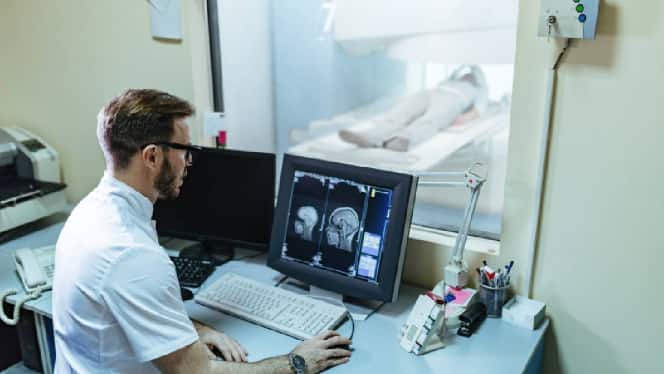
Unlike generative AI systems, REiLI is a regulated medical AI platform designed specifically for healthcare imaging applications. The platform analyses imaging scans to identify abnormalities and assist healthcare professionals in prioritising areas requiring closer attention. For example, in CT scans involving thousands of image slices, the AI can flag suspicious lung nodules, arterial blockages, calcium deposits, or other irregularities that radiologists may need to examine further.
“The AI supports the doctor. Final judgement is always made by the human radiologist,” Morita said.
The company stressed repeatedly that REiLI does not autonomously “learn” in live clinical environments the way consumer AI systems do. That distinction is important because healthcare AI operates within tightly regulated medical-device frameworks across markets, including India, Japan, Europe, and the US.
Why Medical AI Cannot Behave Like Consumer AI
Unlike mainstream generative AI systems, medical AI fundamentally differs in the sense that REiLI cannot continuously self-learn in real-time clinical environments because healthcare AI systems require regulatory approvals for every major update, according to the company. While enterprise chatbots can evolve dynamically through ongoing training, medical AI systems must remain stable, explainable, and regulator-approved.
“Medical AI cannot simply learn by itself after deployment. That is not allowed,” Morita said.
Any major enhancement to the AI model requires validation and approvals from regulatory agencies, such as:
-
India's CDSCO (Central Drugs Standard Control Organisation)
-
US FDA (Food and Drug Administration)
-
Japan's PMDA (Pharmaceuticals and Medical Devices Agency)
-
CE marking under the EU MDR (European Union Medical Device Regulation), overseen by notified bodies and the European Commission.
This means medical AI development follows a far more controlled lifecycle compared to consumer AI ecosystems built on rapid iteration and continuous deployment.
AI is Also Helping Reduce Radiation Exposure
One of REiLI’s more practical use cases involves enhancing low-radiation CT imaging. CT scans are highly effective for detecting abnormalities, but radiation exposure has traditionally remained a concern in preventive screening environments where healthy individuals undergo scans.
Morita claimed that NURA has deployed ultra-low-dose CT systems operating at radiation exposure levels up to 97% lower than conventional scanners. Fujifilm’s REiLI AI platform then reconstructs and enhances the noisier low-radiation images, enabling radiologists to interpret scans at diagnostically usable quality levels.
Without AI enhancement, low-radiation scans would generate images too poor for reliable clinical interpretation. AI is filling the gaps.” This positions AI not merely as a detection engine, but also as an image reconstruction and quality-enhancement layer inside imaging infrastructure.
The Data Backbone Behind REiLI
Fujifilm’s AI capabilities are built on decades of imaging expertise dating back to its origins as a photography and X-ray film company. Over time, the company evolved into a medical imaging, healthcare IT, and AI organisation after expanding aggressively into digital imaging infrastructure and acquiring healthcare assets, including parts of Hitachi’s medical business.
According to Fujifilm executives, REiLI has been trained using large-scale global medical imaging datasets sourced through collaborations with universities and hospitals across Japan, the US, and Europe. The company claimed its imaging datasets extend far beyond the million-image scale commonly referenced by medical AI startups.
Importantly, the AI inference engine operates entirely on-premise within NURA centres rather than on public cloud infrastructure. “All software and AI computation happens locally on-premise,” Morita said.
The architecture includes:
-
PACS (Picture Archiving and Communication Systems)
-
RIS (Radiology Information Systems)
-
LIS (Laboratory Information Systems)
-
HIS (Hospital Information Systems)
The company said imaging workloads are too data-intensive for practical real-time cloud deployment, with some scans generating terabyte-scale imaging data volumes.
This is also tied to patient data protection and cybersecurity requirements.
Blockchain and Healthcare Data Security
NURA executives confirmed that Fujifilm also uses blockchain-based security mechanisms internally to protect sensitive healthcare imaging data.
While details were limited, the company stated that the technology is aimed at ensuring imaging records and patient data remain protected against unauthorised access or tampering. This becomes increasingly relevant as India prepares for stricter implementation of the Digital Personal Data Protection (DPDP) framework.
India’s Preventive Healthcare Opportunity
NURA launched its first Indian centre in Bengaluru in 2021 and has since expanded to cities including Mumbai, Gurugram, Calicut, Chennai, and Hyderabad. The company says it has conducted around 70,000 screenings in India and over 160,000 globally. Interestingly, the firm believes India’s preventive healthcare market is still largely underdeveloped. “We are creating the category itself,” Dr. Kasim said during the interaction.
Unlike diagnostic labs that rely heavily on physician referrals, NURA currently operates largely through direct-to-consumer engagement and word-of-mouth recommendations from individuals who underwent screenings. The company believes post-pandemic awareness around early detection has significantly improved consumer receptiveness toward preventive health checks.
AI Beyond Cancer Detection
Today, NURA’s primary AI focus areas include:
-
Early-stage cancer detection
-
Cardiovascular risk assessment
-
Lifestyle disease monitoring
However, Fujifilm says future AI development will increasingly target age-related mobility disorders, musculoskeletal degeneration, and preventive wellness monitoring. The long-term vision appears broader than conventional diagnostics. Rather than positioning AI purely as a disease-detection engine, Fujifilm is attempting to build AI-assisted longitudinal health monitoring systems capable of identifying future health risks before severe deterioration occurs.
Human Doctors Still Remain Central
Despite the heavy AI layer, the company repeatedly emphasised that doctors remain the final decision-makers. REiLI functions more like an intelligent clinical assistant than an autonomous diagnostic engine. Morita compared the system to spell-check software that alerts clinicians to possible abnormalities but does not replace medical judgment.
That distinction may become increasingly important as regulators worldwide scrutinise explainability, accountability, and clinical transparency in AI-driven healthcare systems. For now, Fujifilm bets that the future of healthcare AI lies not in replacing doctors, but in helping identify diseases earlier, faster, and at a population scale.